
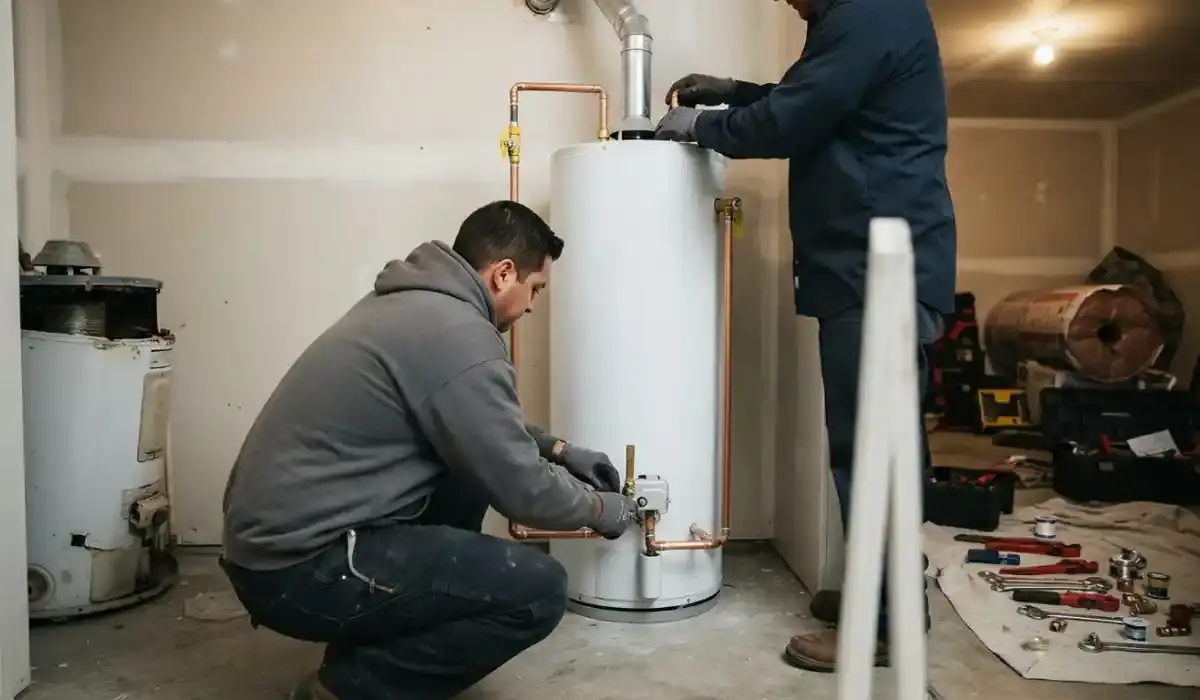
The short answer: outdoor units move the heater out of the house
An outdoor tankless water heater is built to sit on an exterior wall. It does not need an indoor vent pipe, and it frees closet or garage space. It still needs gas, power, water and the right clearances, and it must be rated for outdoor use.
Outdoor units suit homes where indoor venting is hard to route, such as a garage corner with a tight roof or a closet that cannot be changed. They are a poor choice where the wall faces a walkway or where a neighbor fence is close.
Indoor or outdoor: a practical view
Indoor tankless
- Protected from weather.
- Needs a vent through a wall or roof.
- Uses indoor floor or wall space.
- May need condensate drainage.
Outdoor tankless
- Rated for rain and wind exposure.
- No indoor vent run.
- Frees interior space.
- Needs clearances to windows and doors.
What the planning visit covers
Location
We check wall space, clearances and access for service.
Gas
We size the gas line for the unit total input.
Power
We confirm an outlet or circuit for the controls.
Water and drain
We plan supply, return lines and service valves for flushing.
Gas supply and clearances
A tankless heater uses a lot of gas when it fires. A line sized for a tank may be too small. Longer runs need larger pipe. We calculate the load and the run length, and we tell you if the gas line must be upsized.
Outdoor units also need clearance from windows, doors, vents and combustible materials. The manual lists the exact distances. We install to the manufacturer instructions and code.
Questions to settle before you order
| Question | Why it matters | Who answers it |
|---|---|---|
| Is the unit rated for outdoor use? | Indoor units fail outside | Manufacturer spec. |
| Is there a safe wall with clearances? | Code and safety | Plumber on site. |
| Is the gas line big enough? | Starved units shut down | Plumber, gas utility. |
| Where will the condensate go? | High-efficiency units make it | Manufacturer, plumber. |
| What permits are required? | Local rules | City building department. |
Protection, noise and service access
Outdoor units sit in sun, dust and weather, so protect them with proper clearances and keep vents free of debris. Fire safety counts as well, especially where dry brush grows near a property. Keep the area around the unit clear.
Noise from the fan and burner carries, so avoid the wall of a bedroom. Leave a path and enough room for service. A unit boxed in by a fence and a shrub costs more to maintain.
Norco permits, water and what to ask locally
Permit rules for water heater work vary by city. The City of Norco building department can tell you what applies at your address, including any clearance or gas line requirements.
The City of Norco reports hardness between about 122 and 185 mg/L in recent data years. Scale in a tankless heat exchanger is a real concern, so plan service valves for yearly flushing. A water softener can help.
Ask your gas utility about meter capacity if you add a large load.
Source type: City of Norco building department and water quality reports.
Who to call
We install and service tankless units. Our water heater installation page covers choices for tanks and tankless units. We serve Norco, Eastvale and Corona.
If your current heater has failed, call and we will talk through the options.
Outdoor placement: what to check first
An outdoor unit needs clear space for airflow and service access. It also needs a gas line sized for the load, a power connection for the controls and a drain path for condensate if the model makes it. Check each of these before you price the job.
Keep the unit away from windows and doors that open, and away from dryer vents and other exhaust. Wind, dust and irrigation spray all matter, so a protected wall is better than an open yard.
Maintenance that keeps an outdoor unit running
A short routine protects the unit from the weather.
- Flush the heat exchanger on a regular schedule to clear scale.
- Clean the inlet water filter screen.
- Keep leaves, spider webs and debris away from the vents.
- Check the gas and water connections for drips.
- Look at the cabinet for rust or damaged seals.
Outdoor or indoor tankless
| Point | Outdoor unit | Indoor unit |
|---|---|---|
| Venting | Exhausts directly outside | Needs a vent run through the wall or roof. |
| Space | Frees garage or closet space | Takes interior wall space. |
| Weather exposure | Faces sun, dust and wind | Protected. |
| Service access | Often easier | Depends on the closet or garage. |
Questions to settle before installing
Ask whether the gas meter and line can carry the load, whether the unit sits on a stable pad and whether local code requires a permit and inspection. Ask where the relief discharge goes and how the unit is secured. A plain written answer to each question avoids surprises on installation day.
Efficiency and running costs
A tankless unit heats water on demand, so it avoids the standby loss of a tank that keeps water hot all day. That can lower gas use in homes with modest hot water needs. In homes with several showers running at once, the unit may need to be larger.
Look at the maker rating for flow in gallons per minute at your temperature rise. Cold incoming water lowers the flow a unit can supply, so size the unit for the coldest conditions you expect, not the warmest.
Warning signs to act on quickly
Some problems need a quick response.
- A gas smell near the unit. Shut off the gas and call right away.
- Water pooling at the base or the connections.
- Repeated error codes that return after a reset.
- Hot water that fades or swings in temperature.
- Soot, scorching or discoloration around the cabinet.
Service access and clearances
Leave clear space around the unit as the maker requires, and do not store items against it. Service access matters for flushes and part swaps. A unit boxed in by fencing or planters costs more to maintain.
Code note
Outdoor units must be listed for outdoor use and installed to the maker instructions and the UPC-based California Plumbing Code.
Outdoor tankless questions
Yes, if the unit is rated for outdoor use and installed to the manufacturer clearances.
Cold snaps are less common here, but many units include protection. Check the manual for the details on your model.
Through service valves on the hot and cold lines, just like an indoor tankless unit.
Rules vary. Ask the City of Norco building department what applies at your address.
Yes. We install in both cities as well.