
Active leak or surprise water bill: act now
A hidden leak can run for weeks before anyone sees it. Water stains on a ceiling, a hissing wall or a meter that keeps moving are signs to act right away.
Shut off the main valve if water is visible and spreading. If you cannot reach it, turn off the meter valve at the street box. Switch off power to wet areas at the breaker before you touch anything.
Do the meter test yourself first
This simple test tells you whether the leak is real before you call.
- Turn off every faucet and appliance that uses water, including ice makers.
- Find your water meter, usually in a box near the street, and lift the lid.
- Watch the leak indicator, the small triangle or wheel. If it spins, water is moving.
- Note the numbers, wait 30 minutes with water off, then read again.
- If the numbers changed, you have a leak somewhere past the meter.
A moving meter with nothing on points to a leak in the house, the yard or the service line between the meter and the home. Our visit narrows that down.
Where leaks hide, and how we find them
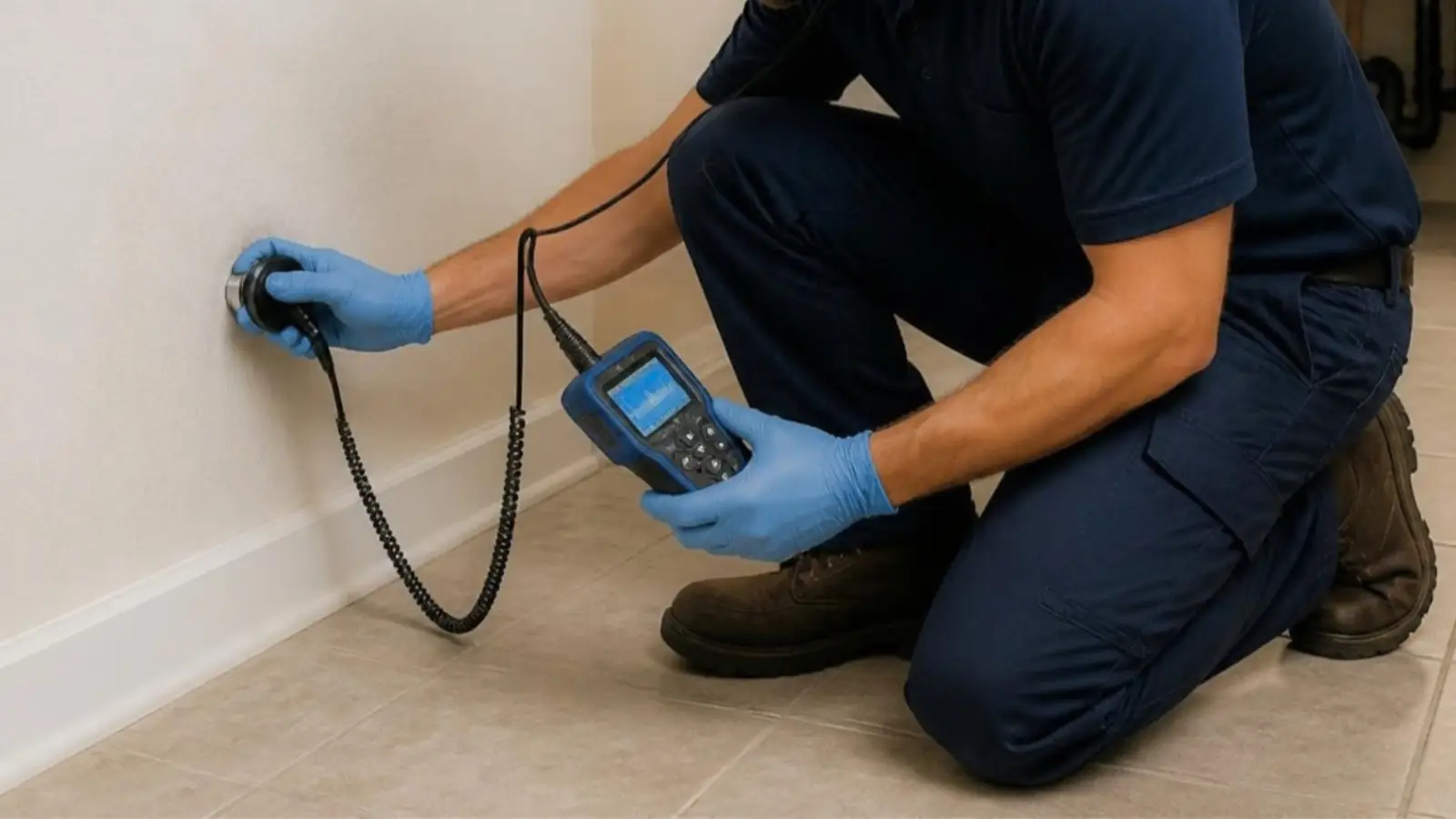
We use non-invasive tools before we open anything, and we name each tool and what it showed.
Under the slab
Acoustic listening and thermal imaging trace a hot water line leak without breaking concrete first.
In the yard
Long service lines on larger lots can leak unseen. We trace and mark the run.
In a wall or ceiling
Moisture meters and thermal cameras find wet framing before mold does.
At a fixture or appliance
Toilet fill valves, supply lines and water heater fittings often leak first.
Water bill climbing for no reason?
Call and we will trace it.
Meter and high bill leaks
A leak you cannot see often shows up as a high bill first. In Norco, properties with room for horses and outbuildings can have long runs of pipe between the meter and the house. That raises the chance of an underground leak that never surfaces.
Ask your water utility for your usage history. We pair that with a meter test and a line trace to find where the water goes. If the leak is in the service line, water line repair is the next step. Our Norco Farms page explains how long yard lines on large lots can hide a leak.
Tools and what they show
| Tool | What it finds | Where it helps |
|---|---|---|
| Acoustic listening device | Sound of water escaping a pressurized pipe | Slab and underground lines. |
| Thermal imaging camera | Temperature changes from wet or hot leaks | Walls, ceilings, floors. |
| Moisture meter | Water inside materials | Drywall, subfloor, cabinets. |
| Pressure test | Pressure drop on isolated lines | Confirming a line leaks. |
Insurance and documentation
Many homeowner policies cover sudden water damage but not slow leaks that run for months. We cannot tell you what your policy covers, so ask your insurer early.
We can write down what we found, where and when, which helps a claim. Take photos of wet areas and keep your water bills.
What happens after we find the leak
Finding the leak is half the job. You choose the repair after you see the cost and the options. A fitting at a fixture is a quick fix. A leak under a slab or in a long yard line may call for a reroute or replacement.
We explain what we found and what it means. If your policy may cover the damage, we document the location and the cause so your claim is easy to support.
What we do not do
We do not tear out walls to look around. We do not guess at the leak location, and we do not recommend a repipe because of a single leak. If we cannot find a leak with our tools, we say so and explain what tests are left.
Not every high bill comes from a leak. A broken irrigation valve, a running toilet or a change in household use can cause the same bill.
How long a hidden leak can run before it shows
A small leak under a slab or in a yard line can run for months before wet ground or a bill reveals it. Meanwhile it can wash away soil, swell flooring and raise indoor humidity.
If your bill rose and you cannot explain why, check the meter before you assume the rate changed. The meter does not lie, and the test takes thirty minutes.
Code and permits
Locating a leak needs no permit. Fixing it can, because new pipe and fittings must meet the California Plumbing Code, which follows the Uniform Plumbing Code (UPC) in its structure.
Leak detection questions
Only when needed. We pinpoint first so the opening is small.
Yes. We use listening tools and meter tests to trace the service line.
A burst pipe is sudden and obvious. A leak can be slow and hidden. For sudden floods, see burst pipe repair.