What the city reports say about Norco water
The City of Norco publishes an annual water quality report. In the 2022 data year it listed average hardness of about 122 mg/L as calcium carbonate, with a range of 54 to 290 mg/L. The 2021 data year showed an average of about 185 mg/L with a range of 21 to 220 mg/L.
The USGS calls 121 to 180 mg/L hard and over 180 very hard. Norco averages sit around those cutoffs. Water varies by where you live and which source feeds your street.
Hardness in the area by utility report
These figures come from each utility report. Grains per gallon are our conversion at 17.1 mg/L per grain, except where the report gives its own.
| Utility | Report figure | Approx. grains per gallon |
|---|---|---|
| City of Norco, 2022 data | Average 122.4 mg/L | About 7. |
| City of Norco, 2021 data | Average 184.8 mg/L | About 11. |
| Corona Department of Water and Power, 2023 data | Average 157 mg/L | About 9. |
| Jurupa Community Services District, 2025 report | Average 162 mg/L | About 9.5. |
Test your tap and ask your water utility for its latest annual report. Your street may differ from the system average.
What hard water does at home
Scale on fixtures
White crust on faucets, showerheads and glass.
Spotting on dishes
Dishwasher leaves film.
Shorter heater life
Scale insulates the burner or elements.
Dry skin and stiff laundry
Soap does not rinse well.
Want your water tested and a system sized?
Call and we will talk it through.
Softener or filter
They solve different problems. Many homes need one, some need both.
Water softener
- Reduces hardness minerals.
- Protects heaters and fixtures.
- Needs salt or regeneration.
- Does not remove chlorine.
Filtration
- Reduces taste, chlorine and some contaminants.
- Choose by what you want removed.
- Needs filter changes.
- Does not soften on its own.
A softener paired with a tankless water heater cuts descaling work.
Before you buy a system
A short checklist avoids buying the wrong equipment.
- Test the hardness at your tap with a strip or ask a lab.
- Read your utility annual water quality report.
- Ask whether the home has a loop or bypass for a softener.
- Check any local rules for brine discharge with your water utility.
- Decide whether you want a whole-house or a single-tap system.
Salt, regeneration and what it takes to maintain one
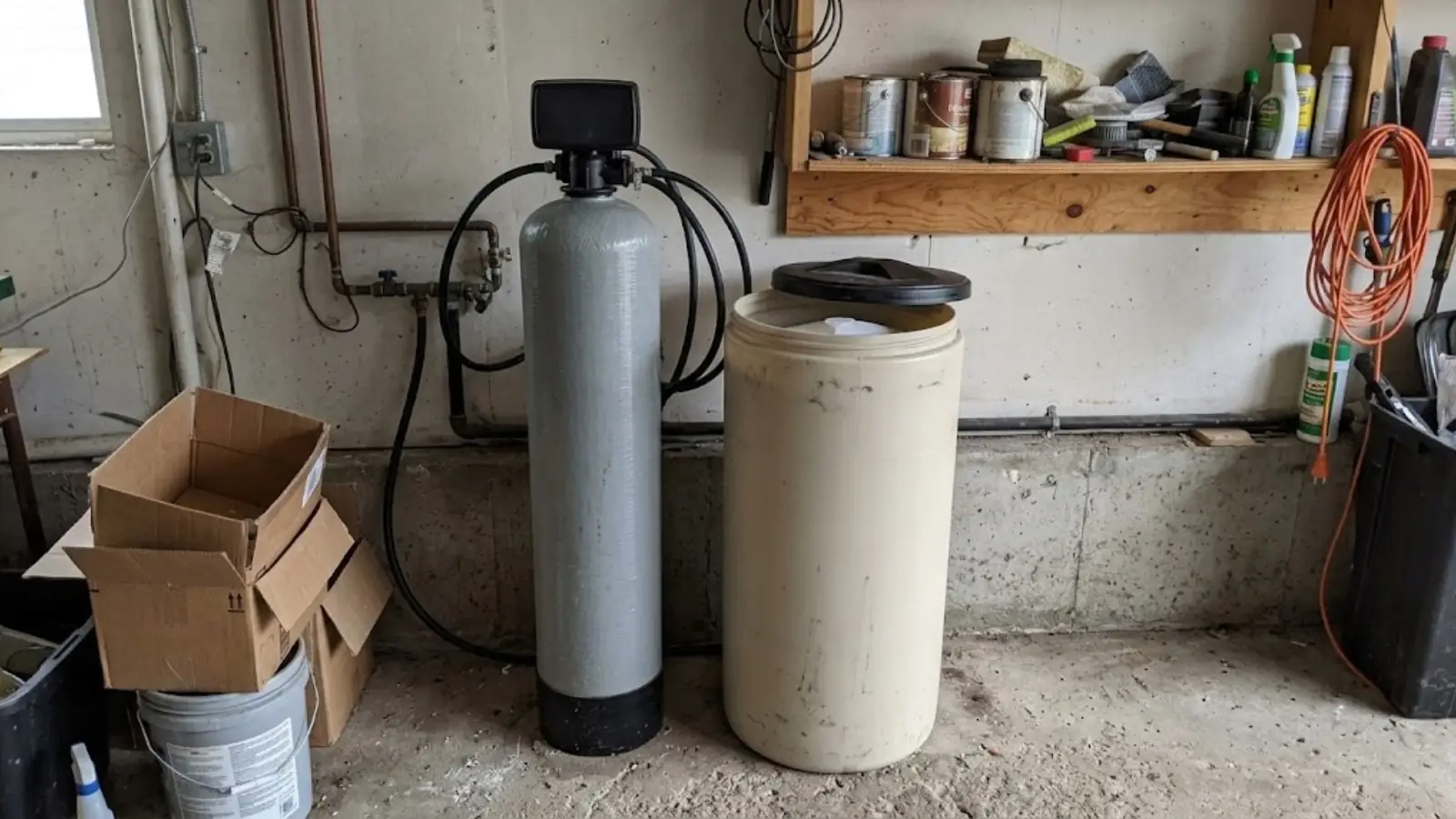
A salt-based softener swaps hardness minerals for sodium or potassium and flushes them away in a regeneration cycle. It needs salt in the brine tank, a drain connection and power. Most owners refill salt every few weeks to months, depending on size and use.
Check with your water utility about any local rules on discharge, and ask your doctor if sodium is a concern. Potassium can replace sodium in many units.
Whole-house filtration
Carbon filters reduce chlorine taste and odor. Reverse osmosis at one tap reduces dissolved solids. Whole-house filters protect fixtures and appliances from sediment. Each solves a different problem, and the right choice follows your water test.
Ask your utility for its report first. It lists what is in the water at the source.
A note on honest expectations
A softener reduces hardness. It does not purify water, and it does not remove chlorine. It also will not fix a leak, a clog or a failing water heater by itself. It reduces scale, which can extend the life of heaters and fixtures.
Test your tap before you buy, and compare the result to your utility report. If your water is already on the soft side, a softener may not be worth it.
Code and permits
Softener installs follow the UPC-based California Plumbing Code for bypass valves, backflow and drain connections. Some cities also limit brine discharge, so ask the City of Norco first.
What shapes a softener or filter quote
The system, the plumbing changes and the drain connection drive the price. We quote before work starts.