
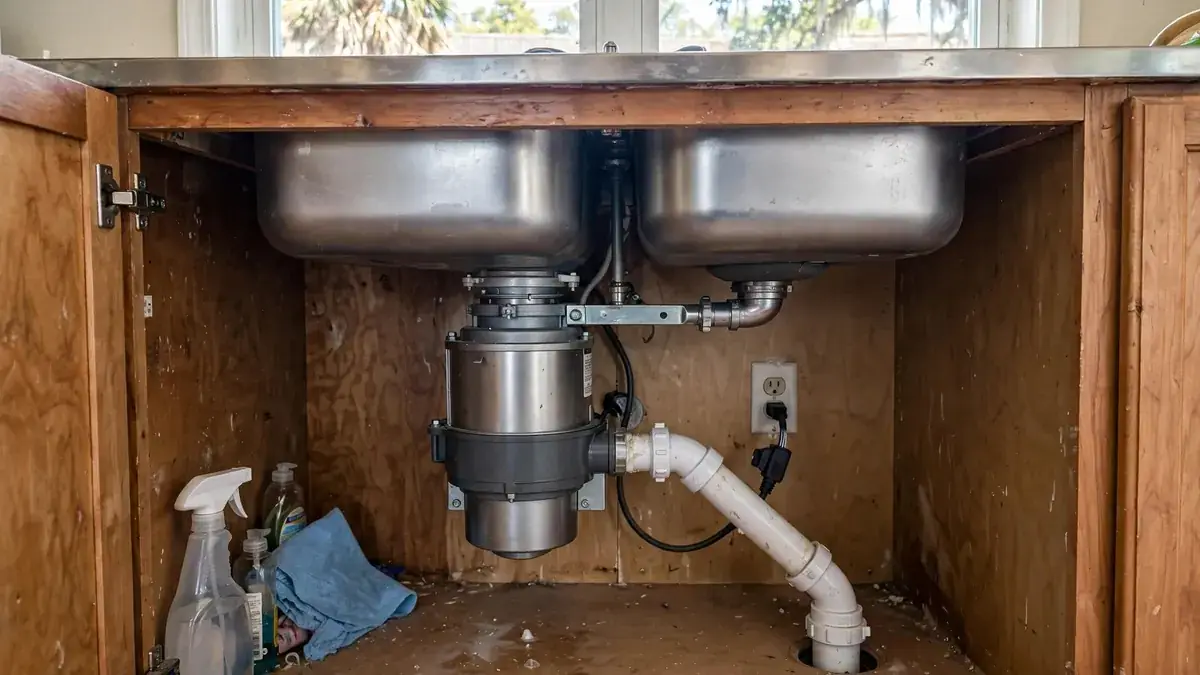
When the disposal fails and the sink backs up
A jammed disposal can back water into the sink and stop a busy kitchen. If the unit hums but will not spin, it is stuck. Turn it off at the switch and unplug it or flip the breaker before you reach near it. Never put a hand into the disposal.
Call us.
Symptoms and common causes
| Symptom | Likely cause | Fix |
|---|---|---|
| Humming, no spin | Jam in the chamber | Free the flywheel with a hex key. |
| No sound at all | Tripped reset or no power | Press reset, check the outlet. |
| Leak from the bottom | Failed seal, unit is done | Replace the disposal. |
| Leak at the top | Loose mount or flange seal | Reseal the flange. |
| Slow drain after use | Clog past the disposal | Clear the drain line. |
How we fix a jam
Power off
We cut the power or unplug the unit.
Free it
A hex key at the bottom turns the flywheel by hand.
Clear
We remove the object, often a bone, a bottle cap or a piece of fruit pit.
Test
We run water and check for leaks.
Disposal leaking under the sink?
Call now and we will plan the repair.
What goes down, and what does not
Disposals handle small soft food scraps. They struggle with bones, fibrous stalks, pits, coffee grounds in large amounts and grease. Grease hardens in the drain line and causes clogs.
Run cold water before, during and after use. Grind small amounts at a time. If your line has clogged more than once, a camera check helps decide between cleaning and repair.
Norco water and the disposal
Hard water, about 120 to 185 mg/L in recent Norco water reports, builds scale on the drain line below the disposal. That scale catches food bits and narrows the line.
A disposal is not the cause of every kitchen clog. If the sink is slow with the unit off, the problem is in the line. Our drain cleaning page covers that.
Installing a new disposal
We remove the old unit, clean the sink flange, set the new mounting assembly and reconnect the drain and dishwasher line. We check that the electrical connection is safe and that the switch works.
Pick a unit sized to your use. A larger motor helps with a busy kitchen. A cord-connected model needs a nearby outlet, and a hardwired one needs a junction box.
Odor and cleaning
Bad smells come from food residue clinging to the splash guard and chamber walls. Grind a handful of ice and a citrus peel, then flush with cold water. Cleaning the underside of the rubber splash guard helps most.
If the odor continues, the drain line past the disposal may be coated with grease. That needs a line cleaning.
Safety rules for any disposal repair
Never put a hand or a tool other than a wooden spoon handle into the chamber. Always cut power at the switch and the breaker, or unplug the unit, before you free a jam. The blades are sharp even when they are not spinning.
If the disposal trips a breaker, stop using it. A repeated trip points to a motor or wiring fault, which needs a plumber or an electrician.
Code and permits
Disposal connections follow the UPC-based California Plumbing Code for traps and drain connections. The electrical side follows separate electrical rules, which is why we advise a qualified person for wiring.
Repair or replace: what changes the price
A jam is inexpensive. A cracked housing or a leak at the seal means replacement, and the price follows the unit.