
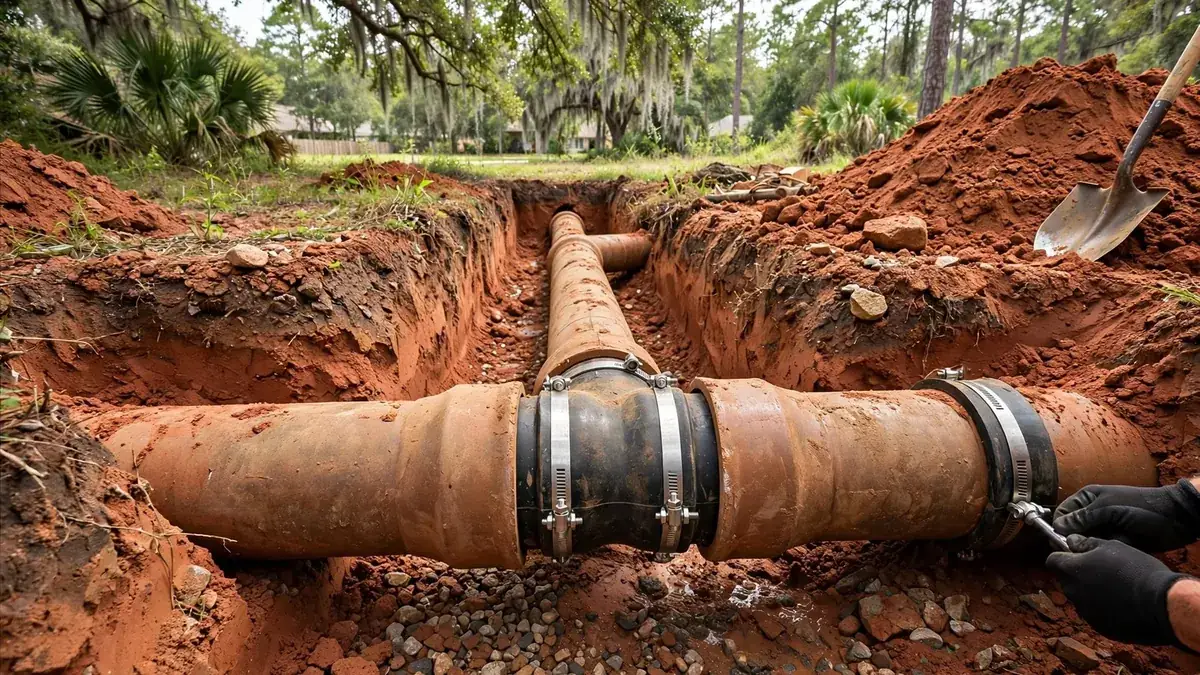
The short answer: cast iron lasts long, but it corrodes from the inside
Cast iron was common in drain and sewer lines in many older homes. It is strong and quiet, but it rusts from the inside and scale builds on the pipe wall. Fittings and joints fail before the straight pipe does.
If your home has cast iron and you have slow drains, rust stains or repeat clogs, a camera inspection shows the real condition. It is cheaper to learn it now than during a backup.
Common cast iron fittings
| Fitting type | How it joins | Where we see it |
|---|---|---|
| Hub and spigot | Spigot end sits in a hub, sealed with lead and oakum or a gasket | Older homes and sewer lines. |
| No-hub coupling | A rubber sleeve with a stainless band joins plain ends | Repairs and newer cast iron. |
| Transition coupling | Joins cast iron to ABS or PVC | Partial replacements. |
| Cleanout fitting | A capped access tee | Along main drains. |
| Sanitary tee and wye | Directs flow from branch lines | Under floors, in walls. |
How cast iron fails
Rust builds layers called tuberculation inside the pipe. That narrows the line, snags paper and grease and eventually thins the wall. Joints leak at the hub, and the bottom of the pipe can corrode through while the top looks fine.
Pipe that hangs on straps can sag when the supports loosen. A sag holds water and causes repeat clogs. A sewer camera inspection can show sags, scale and holes.
Repair choices for cast iron lines
Clean
Cable or hydro jet to remove scale if the pipe is sound.
Spot repair
Cut out a bad section and install a no-hub coupling and new pipe.
Line
A liner can seal a sound pipe with small defects.
Replace
Replace long failed runs with ABS or PVC.
Hydro jetting is not safe on a badly corroded pipe. We scope first so we know what we are cleaning.
Norco homes and older drain materials
The City of Norco says the area was developed starting in 1923 and that the city incorporated in 1964. A home built in that range may have cast iron or clay drains. A newer home likely has plastic. The only way to know is to look.
The city building department can tell you what permits apply to drain and sewer work at your address. Ask what rules apply to replacing a lateral, since requirements vary.
Source type: City of Norco history page and city building department guidance.
When to call a plumber
Call when you see rust stains on a pipe, damp spots under a slab or a main line that clogs more than once a year. We can repair or replace sections with minimal disruption.
How to tell what your pipe is made of
Cast iron is heavy, dark gray and rough, and it rings dull when tapped with a wrench. Plastic pipe sounds hollow and is lighter. Galvanized steel is thinner, threaded and often rusty at the joints. If you cannot tell by sight, a plumber can identify the material in minutes.
Look in the crawl space, a garage wall, a basement or near the water heater closet where drain lines are exposed. Homes with slab foundations often hide the lines, and a camera is the way to see them.
Signs the pipe or fitting is failing
| Sign | What it often means | Next step |
|---|---|---|
| Rust stains at joints | Weeping gasket or corroded hub | Have the joint inspected. |
| Slow drains in several fixtures | Scale narrowing the main line | Camera and cleaning. |
| Sewer smell near a wall | A cracked fitting or dry joint | Locate and repair the leak. |
| Repeated backups | Heavy scale, offset joints or roots | Camera inspection. |
| Flaking inside the pipe on camera | Advanced corrosion | Plan a section replacement. |
Repair options in plain terms
A failed section can be cut out and replaced with plastic pipe, joined to the old iron with a no-hub coupling or a transition fitting. This is the most common fix when only one stretch is bad. It keeps the opening small and the cost down.
When corrosion runs the full length, replacing the whole run is often wiser than patching it one joint at a time. Some lines can be lined from the inside, but lining needs a clean pipe and a sound shape, which the camera must confirm first.
Questions to ask before approving work
A clear written scope makes quotes easy to compare.
- Ask to see the camera video of the section being replaced.
- Ask which fittings and pipe material will be used.
- Ask whether a permit is needed and who pulls it.
- Ask what happens to the wall or floor finish.
- Ask for the plan in writing before work starts.
Why fittings fail before the pipe does
Joints carry more stress than straight pipe. Lead and oakum seals dry and shrink over decades, and rubber gaskets harden. Ground movement and heavy loads can pull a joint apart even when the iron around it is still solid.
This is why a camera trip is useful. It shows a cracked hub or an offset joint that a simple cleaning will not fix, and it keeps you from paying to clear a line that needs a repair instead.
Noise, smell and what they tell you
Gurgling after a flush points to venting or partial blockage. A sewer smell near the wall points to a dry or failed joint. A damp spot on the slab or the crawl space floor near a drain line means a leak. Each clue narrows the search, and the camera confirms it.
Why a quote should name the fitting
A good quote says whether the plumber will use a no-hub coupling, a transition fitting or a full replacement section. It also says how the new pipe is supported. Vague wording like "fix the line" leaves room for surprises, so ask for the plan in plain terms.
Permits and inspections
Drain and sewer work often needs a permit, and the city may inspect the finished repair. Ask the City of Norco building department what applies to your address, and ask your plumber who pulls the permit. Unpermitted work can cause trouble at resale.
Code note
Replacement pipe and fittings must meet the California Plumbing Code, which is built on the Uniform Plumbing Code (UPC).
Cast iron questions
Many lines last decades, but life depends on water, soil and use. A camera shows the real condition.
Yes, with a proper transition coupling. A plumber should install it to code.
It can raise questions at inspection. A camera inspection helps you decide.
Permit rules vary. Ask the City of Norco building department what applies at your address.